• About
  • Guest Speaking and Trunk Show Information

The Plain Needlewoman

~ Quilt Study, Sewing, Vintage Textiles, Collecting quilts and other old odds and ends.

The  Plain Needlewoman

Category Archives: hand quilting

Nanna Good’s Ocean Waves Quilt.

18 Wednesday May 2016

Posted by mcinnesjanette in antique fabric, Feed Sack, hand quilting, old fabrics, old quilt tops, Old Quilts, Postage Stamp Quilts, Quilt Collections, Quilt Stories, Scrap quilts, Uncategorized, vintage quilts

≈ 2 Comments

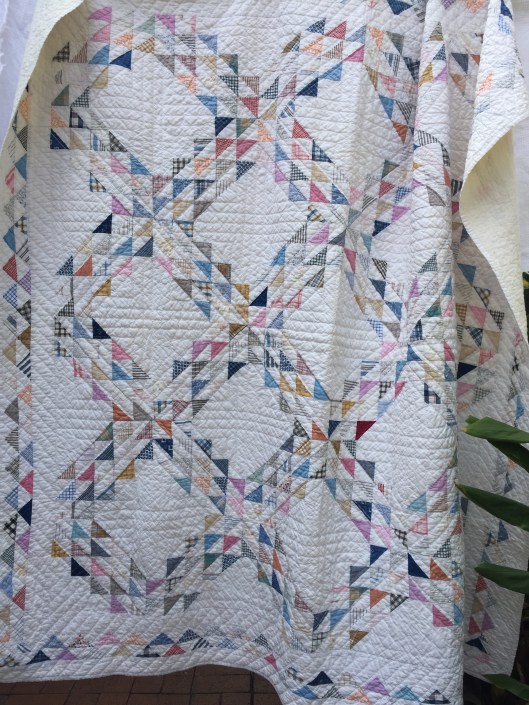
IMG_4073

This Ocean Waves Quilt was made by Nanna Good in Orrick, Missouri, USA. It was passed down to her daughter Kathryn Sue Bogart McAfee. Kathryn was born on the 21 December 1922 and died in 1982. The quilt was then passed onto her only ancestor – a grand daughter. Her grand daughter decided to sell this quilt as she has a number of quilts made by her mother and grand mother that were made specifically for her. This one was not one of them.

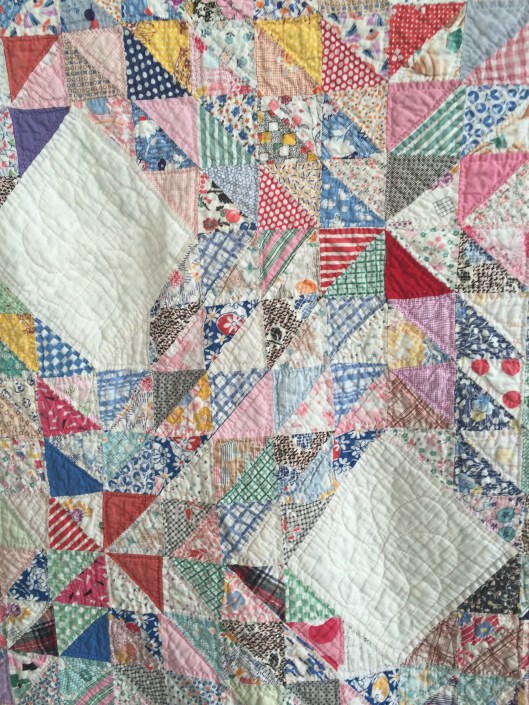
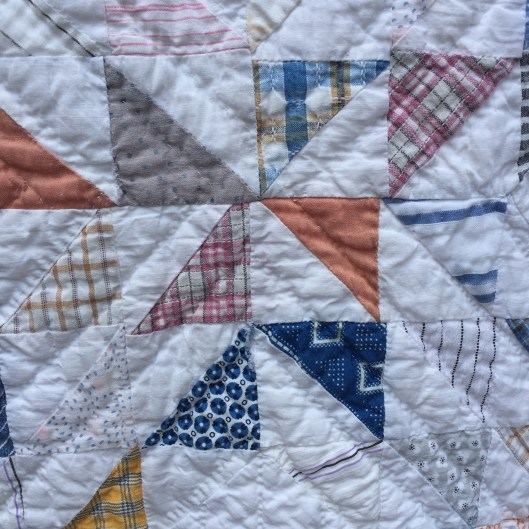
Detail of fabrics

Detail of fabrics

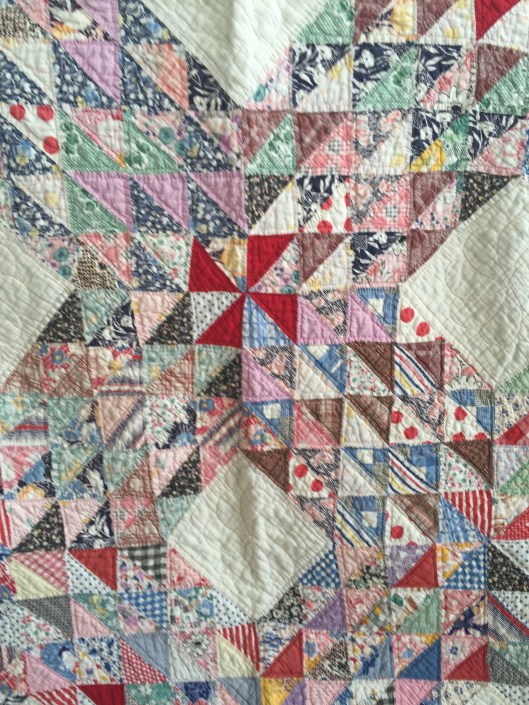
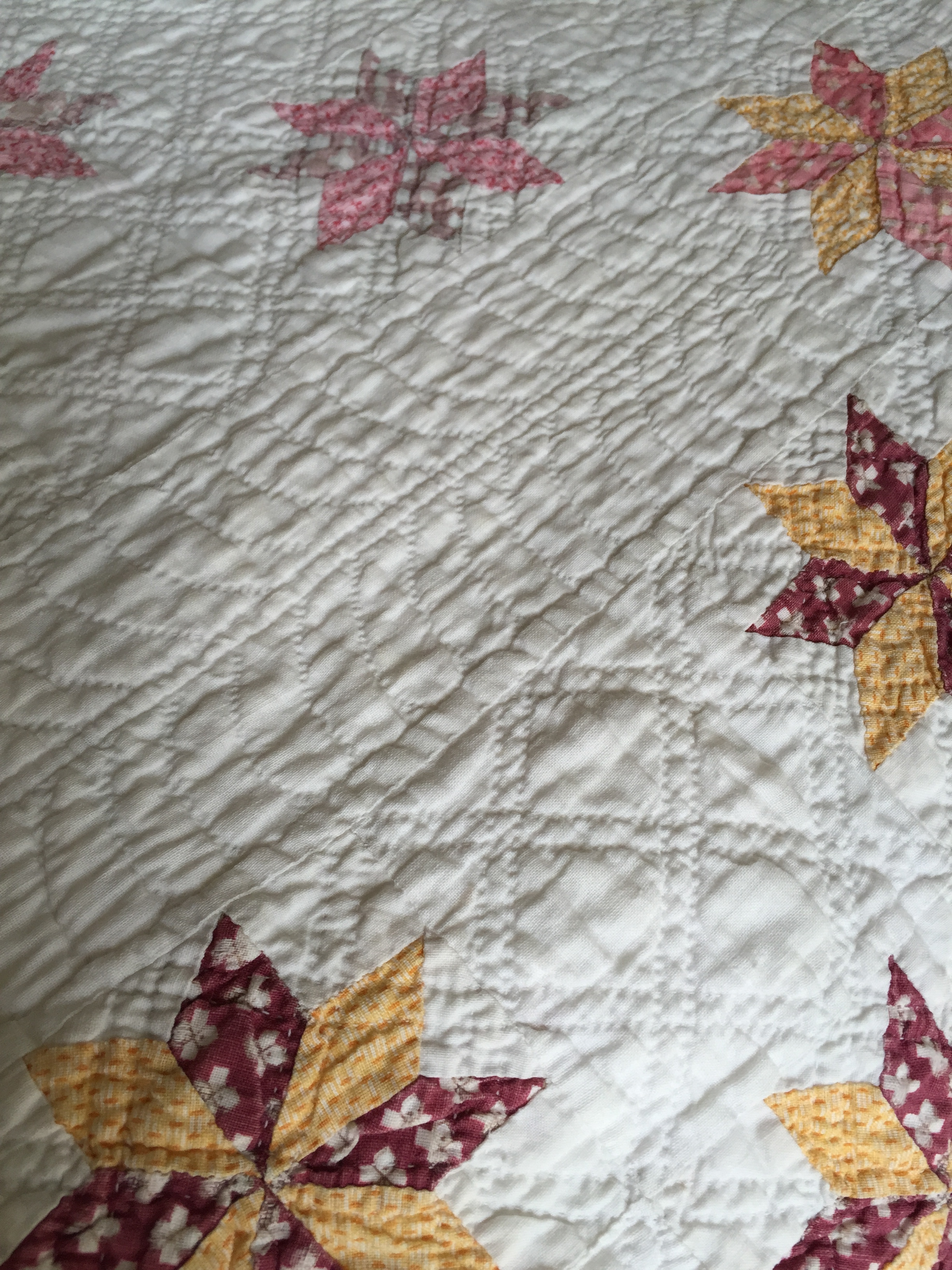
This lovely, scrappy version of the Ocean Waves pattern epitomises a Thirties quilt. The fabrics include florals, solids, stripes, juvenile prints and a couple of pieces from an earlier era. The placement of the solid red creates the effect of pinwheels across sections of the quilt.

Red Pinwheel

Red Pinwheel

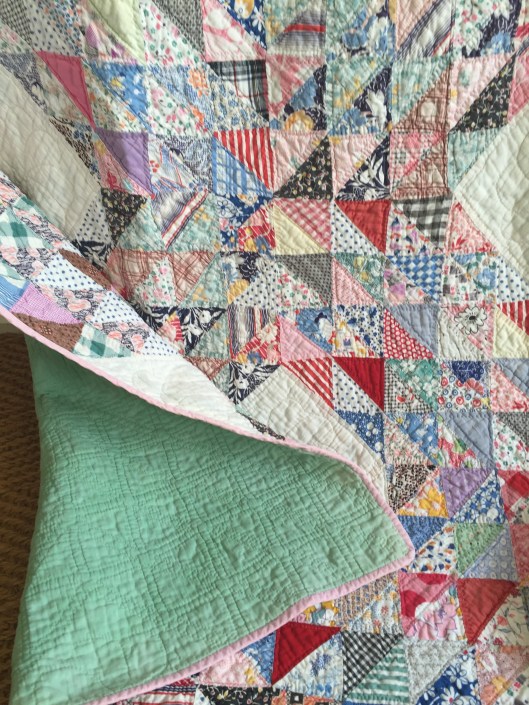
The backing is a wonderful Thirties green and the binding a pretty pink. The quilt is quilted by the piece with a simple design in the plain areas. The batting is an uncarded cotton. The seeds are clearly visible when the quilt is wet.

Quilt backing and binding

Quilt backing and binding

Ruby Short McKim published a pattern for an Ocean Waves Quilt in 1931, although we see many earlier examples. It is a very effective design in a two colour combination as well as a great scrap quilt.

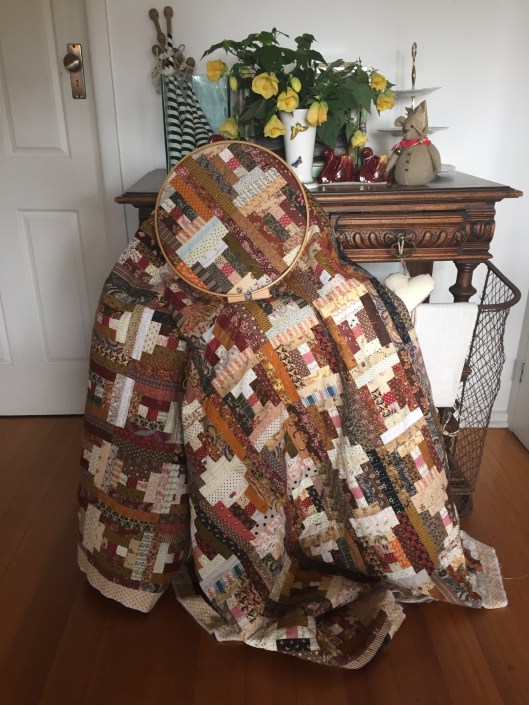
I have been busy with hand quilting and have just completed my Courthouse Steps quilt.

Courthouse Steps made with mid 19th century fabrics.

Courthouse Steps made with mid 19th century fabrics.

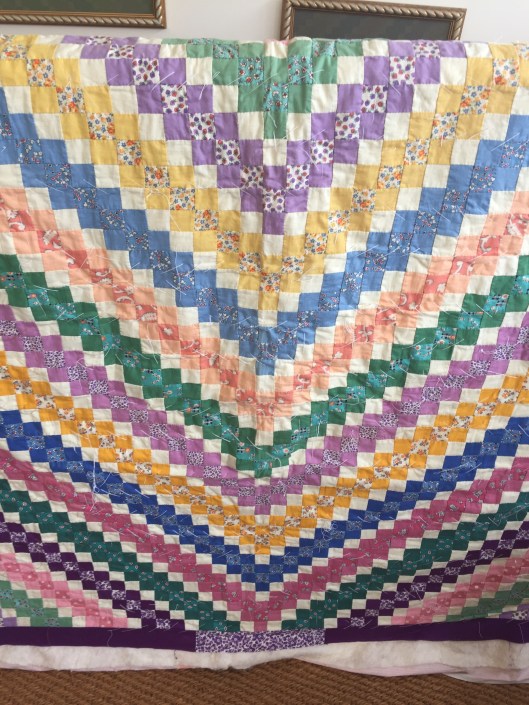
I am now settling in for the Winter months and have commenced the quilting of another of my old quilt tops. This one is a Trip Around The World – a very large quilt made of very tiny squares.

Trip Around the World.

Trip Around the World.

I hope your quilting is bringing you much pleasure. Thank you for stopping by, Warmly Janette

Darting Birds

09 Saturday Apr 2016

Posted by mcinnesjanette in antique fabric, antique quilts, Double Pinks, hand quilting, Mending, Old Quilts, Uncategorized

≈ 5 Comments

Tags

Antique Quilts, Fabric Study, old quilts, quilt collections, quilt study, vintage quilts

IMG_3925

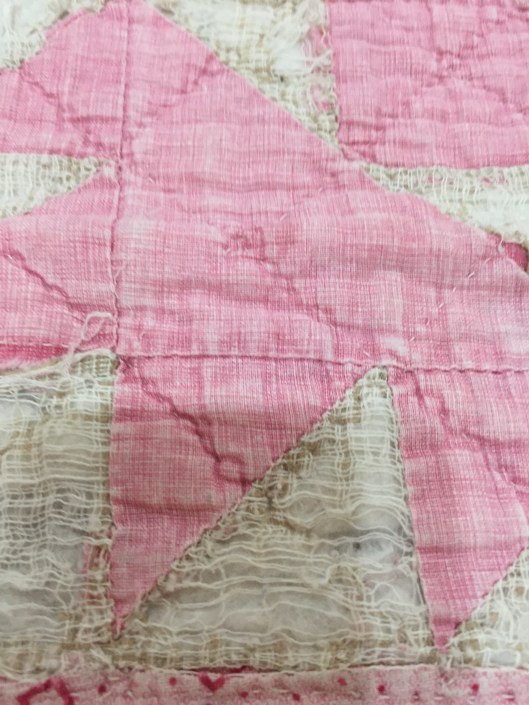
I purchased this charming old quilt as a ‘cutter quilt’. This is the term used for quilts that are in a very sad condition and can be cut up for small projects with out feeling guilty about cutting up an old quilt. I could see it had potential for salvaging into small keepsake pieces.

A heart shape cut from the Darting Birds quilt .

A heart shape cut from the Darting Birds quilt .

When the quilt arrived in the mail, I realised I could not contemplate cutting up this beautiful old quilt. I identified the block pattern in Barbara Brackman’s Encyclopedia of Pieced Quilt Blocks as Darting Birds designed by Nancy Page.

The maker of this quilt had a good collection of fabrics dating from the 1880s to 1900s, including the gorgeous double pink used in the alternate blocks. The birds are pieced from reds, blacks, indigos and browns. The patterns are florals, checks, stripes and polka dots. The backgrounds of the blocks are mostly shirtings.

Detail of fabrics.

Detail of fabrics.

Darting Birds block

Darting Birds block

The beautiful backing fabric used on this quilt was a pleasant surprise as the seller had not mentioned this. The majority of old quilts have plain muslin backings.

Gorgeous backing fabric on display.

Gorgeous backing fabric on display.

Obviously made by a skilled needlewoman the piecing is neat and accurate. The hand quilting stitches are tiny and even and the maker chose cross-hatching for her quilting design.

Most of the wear on the Darting Birds quilt was on the outside edges. I decided to cut the outside rows off the four sides of the quilt. Removing the damaged area has provided me with some scraps for cutter quilt projects. I stitched a new binding – nice and narrow in keeping with the original. Even though some of the remaining blocks are worn, I can still admire and enjoy this old and obviously much loved quilt. I hope you can too!

Softly aged and worn.

Softly aged and worn.

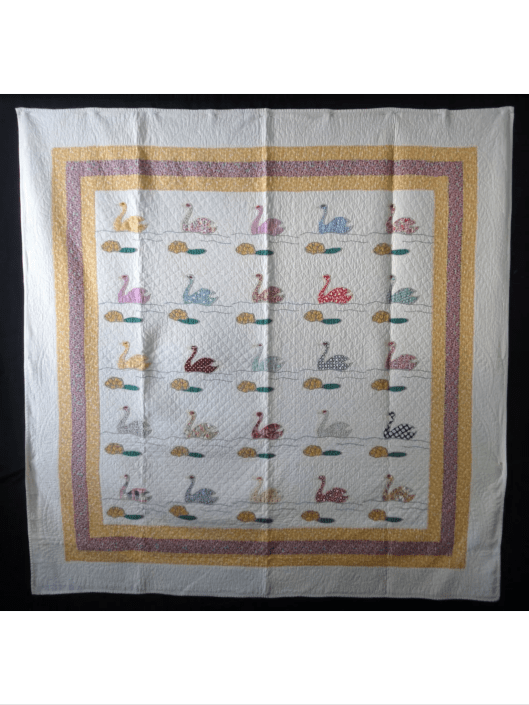
Swans on Lily Pads circa 1930s

24 Sunday Jan 2016

Posted by mcinnesjanette in antique fabric, appliqué, Feed Sack, hand quilting, old fabrics, Old Quilts, Scrap quilts, Uncategorized, vintage quilts

≈ 6 Comments

Tags

1930s quilts, Fabric Study, feed sacks, hand quilting, old quilts, quilt collections

IMG_0155

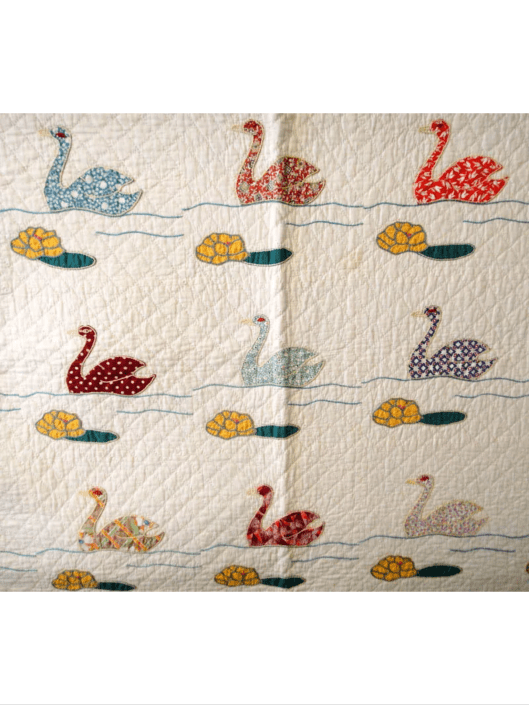
From Fairy Tales to Ballets, swans have provided ideas and inspiration for many artistic pieces.

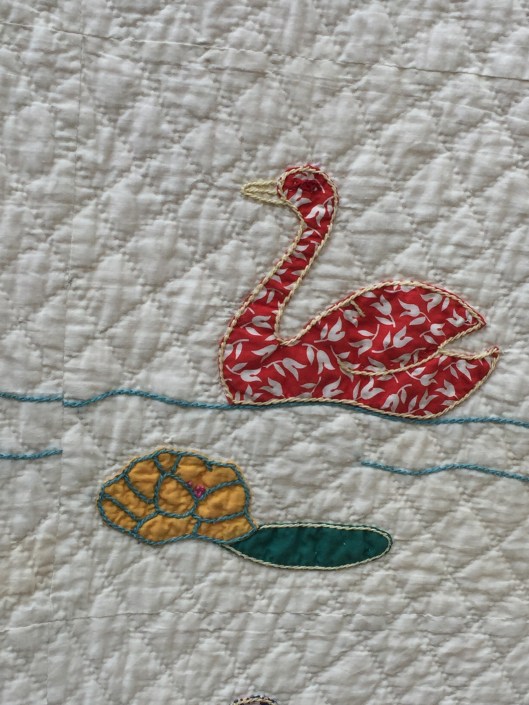
Swans certainly inspired the creation of this unique quilt. Using fabrics from her feedsack scraps and her fine sewing skills the quilter produced a magnificent example of folk art.

Detail of Swans on Lily Pads

Detail of Swans on Lily Pads

Searching through my books and magazines for a pattern source I have been unable to find any patterns for appliqué swans. However, there are many patterns for embroidered swans. Swans were popular motifs for fancy work and examples can also be found on redwork quilts. The maker of the ‘Swans’ may have drawn her own design or found her pattern in a newspaper, magazine or embroidery booklet.

The maker had a good collection of feedsack fabrics. There are 21 different patterns used in the quilt and the yellow solid backing fabric may be a plain feedsack fabric. There are 25 blocks. The quilt is finished with three borders – two of feedsack prints (also used for swans) and the final border is plain homespun.

Detail of quilt backing

Detail of quilt backing

The swans and the lily pads are appliquéd with turned under edges and embroidered with stem stitch. Further details are embroidered. The embroidery and quilting is very well executed. The maker used a soft batting and the quilt displays IMG_3537IMG_3538 traditional quilting designs. Cross-hatching was stitched across the blocks and a beautiful feather design was chosen for the border.

As a collector of old and vintage china swans this quilt is a favourite of mine. I hope you enjoy seeing it.

China Swans

China Swans

More swans from my collection

More swans from my collection

Wishing you all a wonderful year of stitching. Janette – The Plain Needlewoman

Annie Mary H. Gehris Redwork Quilt

29 Tuesday Dec 2015

Posted by mcinnesjanette in antique quilts, hand quilting, quilting projects, Red and White quilts, Redwork, Signature Quilts, Spider Webs, Turkey Red

≈ 3 Comments

Tags

Antique Quilts, Kate Greenaway, Redwork Quilts

IMG_3615

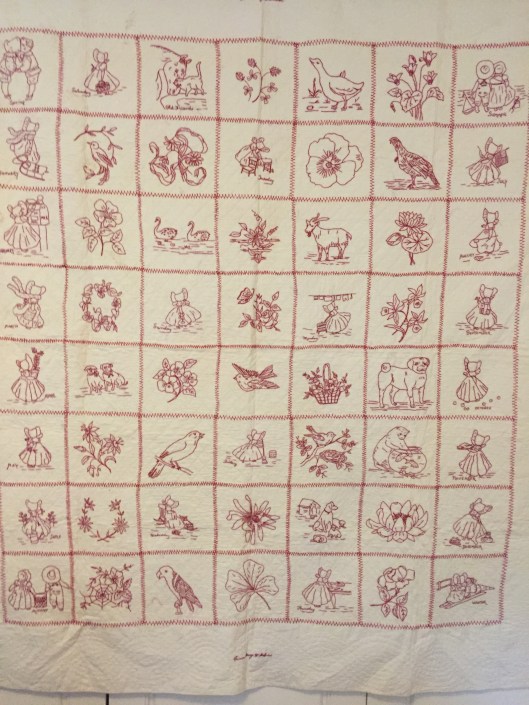
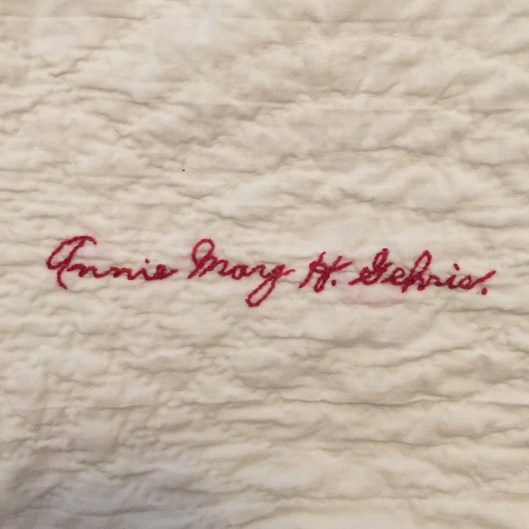
One hundred years ago Annie Mary H. Gehris proudly embroidered her name and the year onto the borders of her redwork quilt. IMG_3619<i

Annie was obviously very pleased with her neatly stitched quilt. Annie added her name to both the top and lower borders and the date ‘1915’ is centred on both the side borders.

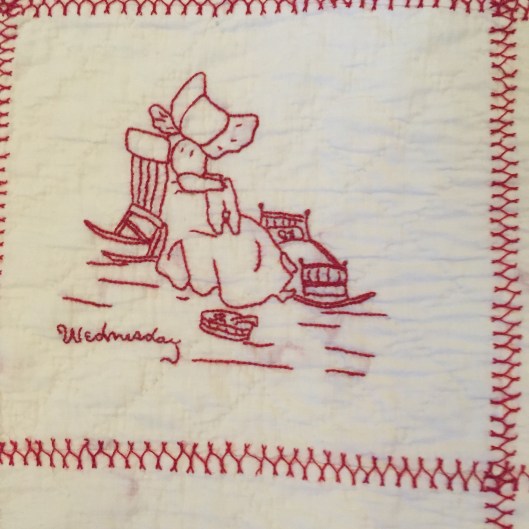
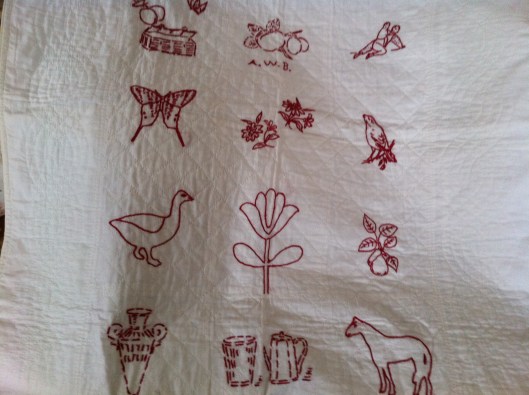
There are 56 blocks featuring the seasons, the months and the days of the week. Little Kate Greenaway figures are carrying out their daily chores and enjoying seasonal activities.

Kate Greenaway figure for December

Kate Greenaway figure for December

Wednesday's chores

Wednesday’s chores

These motifs are placed beside a parrot, a goat, pug dogs, swans and many other designs.IMG_3622IMG_3624IMG_3613IMG_3627IMG_3625

Herringbone stitch was embroidered over the seams. The quilt has nice wide borders quilted with the classic cable designs. The blocks are quilted with cross-hatching. There is a very fine batting in the quilt, possibly hand carded cotton. The quilt appears to have never been used.

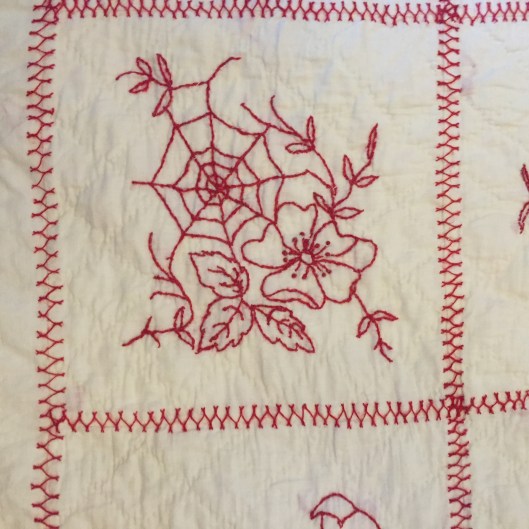
A spider's web for luck

A spider’s web for luck

As we say farewell to 2015 it is the perfect time to reflect on our quilting past and present. The women of the past found time to do needlework through all kinds of trials, as we do today. Whether you plan to finish quilts already started or commence new projects may you find much joy in your quilting in the New Year.

Wishing you a wonderful year ahead, Janette – The Plain Needlewoman.

Redwork – Excellence with the Needle

21 Monday Dec 2015

Posted by mcinnesjanette in antique quilts, hand quilting, Quilt Collections, Redwork, Turkey Red, vintage quilts

≈ 6 Comments

Tags

embroidery, hand quilting, Redwork

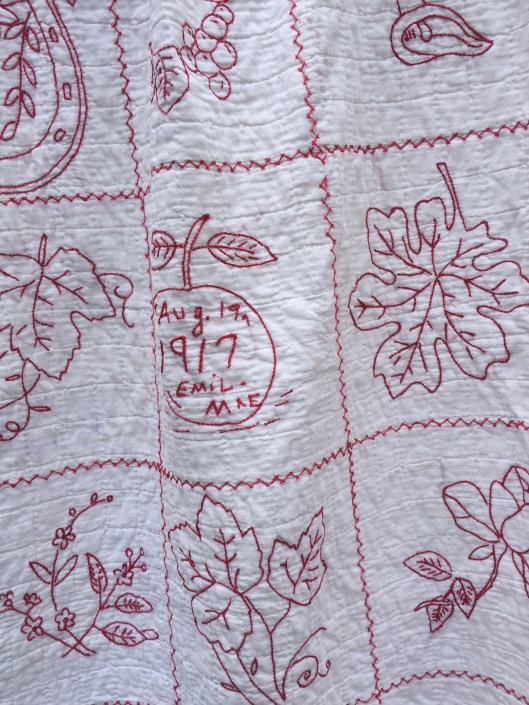
Emil. Mae's Redwork quilt dated August 1917

Emil. Mae’s Redwork quilt dated August 1917

The popularity of Redwork during the period of 1885 to 1925, coincided with the development of a colourfast dye that produced a lovely clear red. The name given to this red was Turkey Red. The name came from the country where this difficult and complicated dyeing process was created and produced under much secrecy. Even today it is not known beyond all doubt how the original methods were carried out.

Patterns for Redwork were published in the Women’s Magazines such as The Ladies Home Journal, The Modern Priscilla and Godey’s Lady’s Book. Stamping Kits and Patterns were offered to entice customers to take out subscriptions. This is an early example of advertising. The patterns used in Redwork were not specifically for quilts, but for all household linens. They were also known as Penny Squares, Storybook, Pictorial or Nursery Rhyme designs.IMG_3520

Due to the simplicity of Redwork and the basic requirements needed Redwork was a good project for beginners and children. Redwork quilts were often made up without batting and in some instances they were simply backed and not quilted.

A story book Redwork quilt -quilted without batting

A story book Redwork quilt -quilted without batting

A stanza from The Needles Excellency by John Taylor published in 1631 describes embroidered pictures. It is also a fitting description of the variety of images found on Redwork quilts made nearly 300 years later.

“Flowers, Plants and Fishes,
Beasts, Birds, Flyes and Bees,
Hills, Dales, Plains, Pastures,
Skies, Seas, Rivers, Trees,
There’s nothing ne’er at hand or farthest sought
But with the needle may be shap’d and wrought.”

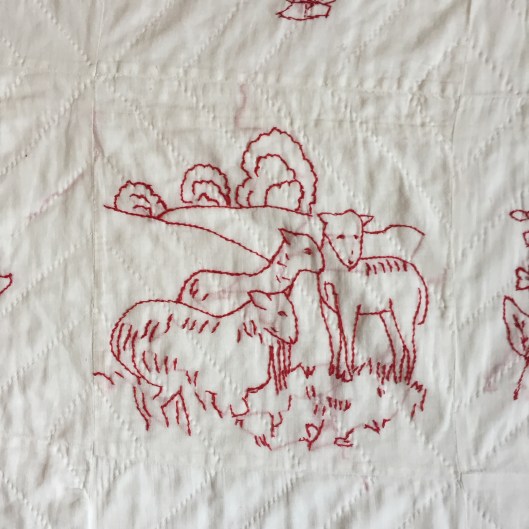
Sheep in the Meadows

Sheep in the Meadows

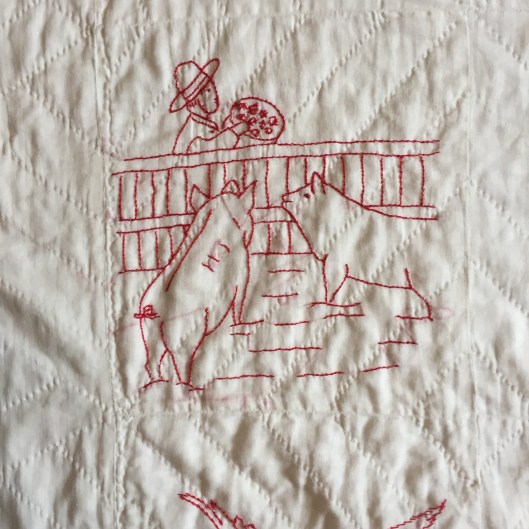
Pigs in the Farmyard

Pigs in the Farmyard

Horses - a favourite subject

Horses – a favourite subject

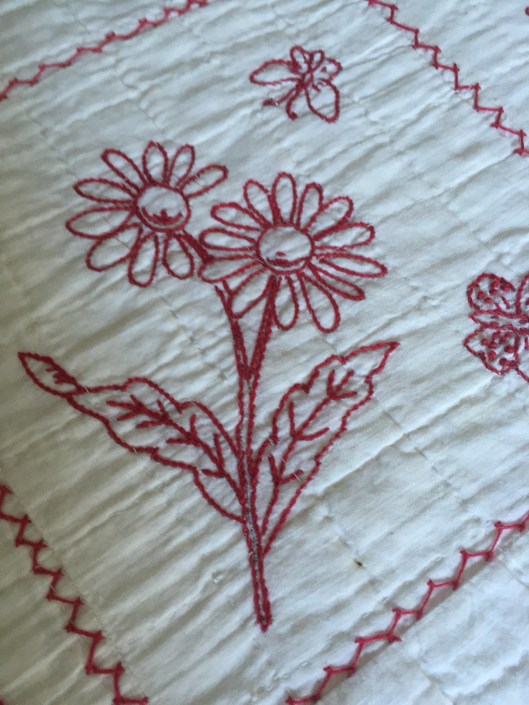
Daisies

Daisies

A Crib Quilt

A Crib Quilt

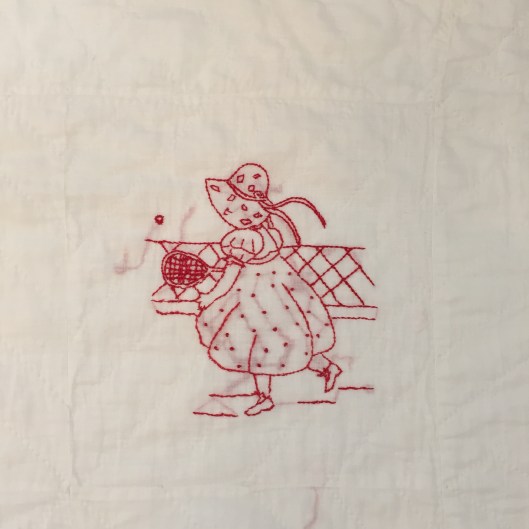
Any-one for tennis?

Any-one for tennis?

Wishing you all a safe and peaceful Christmas. I hope you find time during the busy festive season to spend in pursuit of excellence with the needle. Sending my best, Janette – The Plain NeedlewomanIMG_3510

Irva’s Ocean Waves Quilt

06 Sunday Dec 2015

Posted by mcinnesjanette in antique fabric, antique quilts, Feed Sack, hand quilting, old fabrics, Scrap quilts, Uncategorized

≈ 10 Comments

Ocean Waves quilt made 1932

Ocean Waves quilt made 1932

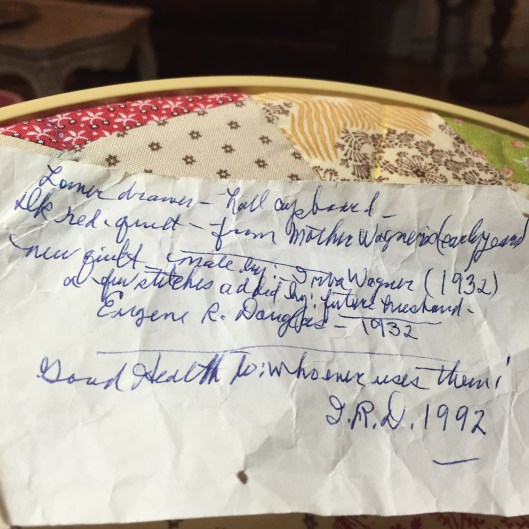
Hand written note

Hand written note

A hand written note attached to this quilt provides an insight into the quilt’s story. The note tells us that the quilt was made in 1932 by Irva Wagner with ‘a few stitches added by her future husband Eugene R. Douglas 1932’. A sentimental note was added to this information wishing ‘Good Health to who ever uses them. I.R.D. 1992’ At the top of the note there is reference to a Dark Red Quilt from Mother Wagner’s early years.

One can presume that the note was written when the quilts were being passed down through the family. On this tiny scrap of paper much information is revealed – the maker’s maiden name, her future husband’s name and the year the quilt was made. The addition of the note, stating that a few stitches were added by her future husband indicate that Irva was stitching this beautiful quilt for her approaching marriage and her new life ahead.

The quilt is hand stitched from many small scraps. The fabrics include shirtings, plaids, ginghams, feed sacks and dimities. The soft palette used certainly suits the quilt’s name – Ocean Waves. Shades of blues, pinks, beiges, reds, mauves and a touch of orange and black were selected from scraps, some dating back to the turn of the century. Placed next to a crisp white background, the quilt evokes a Summer’s day spent looking over the ocean with the constant ebb and flow of the waves. The quilt is beautifully hand quilted.

Detail of fabrics and hand quilting

Detail of fabrics and hand quilting

Detail of piecework

Detail of piecework

Border detail

Border detail

With the prospect of a long, hot, dry Summer ahead, I am happy to have Irva’s Ocean Waves quilt in my collection to remind me of the cool ocean breezes coming in from our bay.

Irva's Ocean Waves

Irva’s Ocean Waves

Thank you for visiting and hope the weather is kind to you all whether it be Winter or Summer in your part of the world. Janette – The Plain Needlewoman

The ‘Collins’ Quilt – circa 1840s

01 Thursday Oct 2015

Posted by mcinnesjanette in antique fabric, antique quilts, Double Pinks, hand quilting, handquilting, Mending, old fabrics, Quilt Stories, Scrap quilts, Signature Quilts

≈ 6 Comments

Tags

1840s Quilts, Antique Quilts, Fabric Study, quilt collections, quilt study

IMG_3036
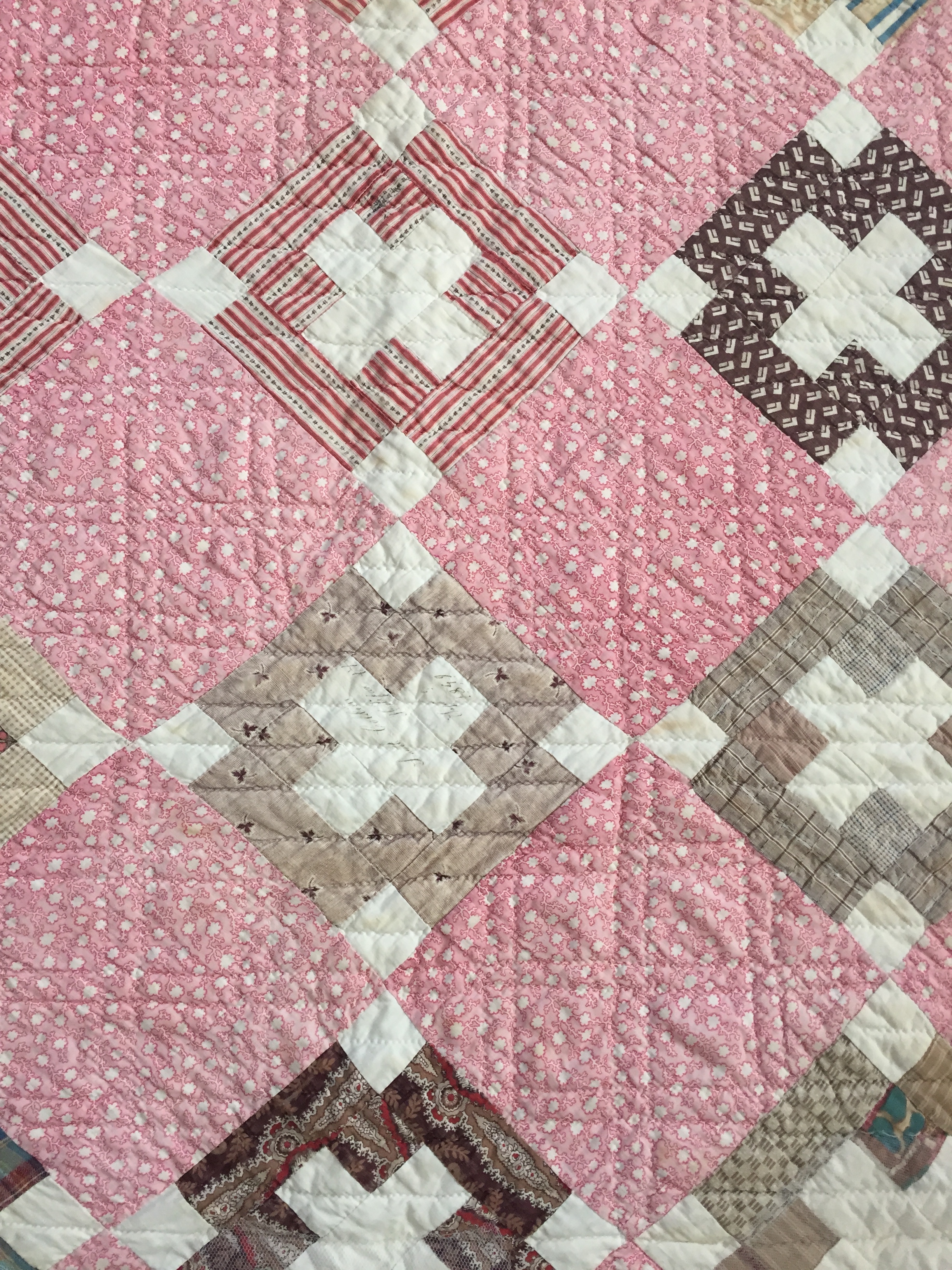
The ‘Collins’ quilt was purchased by Eileen and Bernie Donnelly in 1994 from Peterborough, New Hampshire, USA. It is a lovely old Album quilt with signatures of the Collins family and dated 1849. The names on the quilt are Thomas G. Collins, Samuel B. Collins, Smith Collins, Daniel Collins and Mrs Lewis Collins. They also added their location as Halifax and West Halifax.

The block is a simple but appealing Album Block. There are 49 blocks set on point with an alternate plain block in a lovely double pink and white floral. The blocks are pieced from scraps so there is a good variety of interesting fabrics to study.

Detail of blocks

Detail of blocks

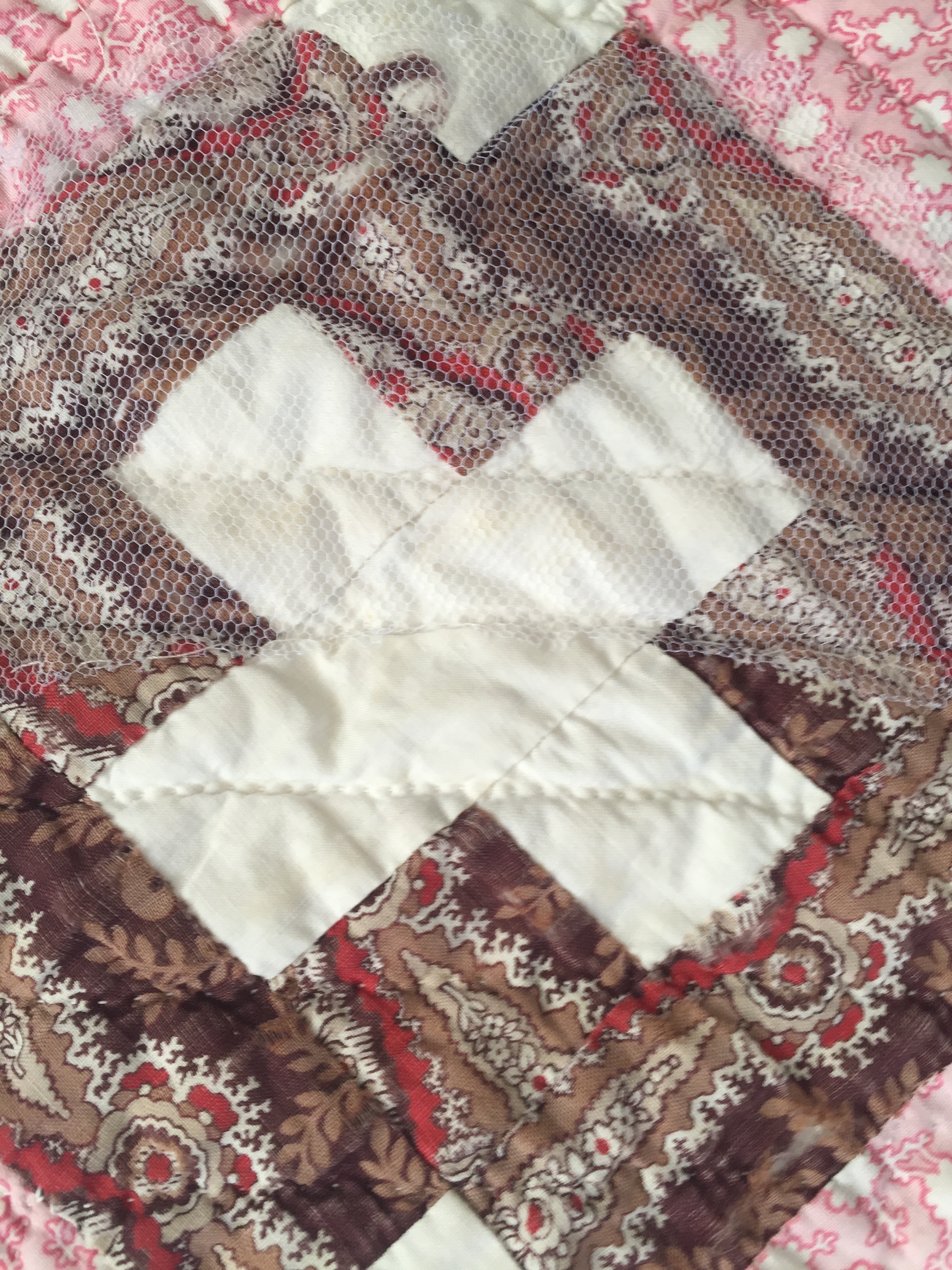
There is some wear to this quilt due to its age and it appears to have been well used. Eileen has noted that a brown fabric has disintegrated, due to mercury being used in the dyeing process of brown fabrics in those days. Eileen has carefully stitched tulle over these areas to protect the fragile fabrics. The quilt backing is a plain cream calico. The quilt is hand pieced and hand quilted.

Tulle stitched onto the quilt to protect a fragile area.

Tulle stitched onto the quilt to protect a fragile area.

Bernie researched the history of the family and traced the Collins family to New England. Bernie traced the family back to 1740 to a Daniel Collins who married Alice Pell in New London, Connecticut in approximately 1762. Daniel and Alice were the Great Grand Parents of those who signed the quilt. Bernie also found a Robert Collins who married Ruth Browning in New London in 1809. They had 10 children including Lewis 1817, Daniel 1819, Samuel 1823 and Thomas G. 1831. These signatures are on the quilt along with Mrs. Lewis Collins. (perhaps she was widowed). Thank you Bernie and Eileen for the wonderful research and preservation work on the ‘Collins’ quilt and for providing me with the information.IMG_3027

Hope you enjoyed the story of the ‘Collins’ Quilt. Happy Quilting from Janette – The Plain Needlewoman

Perfect Piecing

07 Monday Sep 2015

Posted by mcinnesjanette in hand quilting, Mending, old fabrics, Old Quilts, Quilt Stories, Repairing old quilts, Scrap quilts, stitching, vintage quilts

≈ 1 Comment

Tags

1860 to 1880, hand piecing, hand quilting, quilt study, Star Quilts

IMG_3149

LeMoyne Star Quilt circa 1860 to 1880

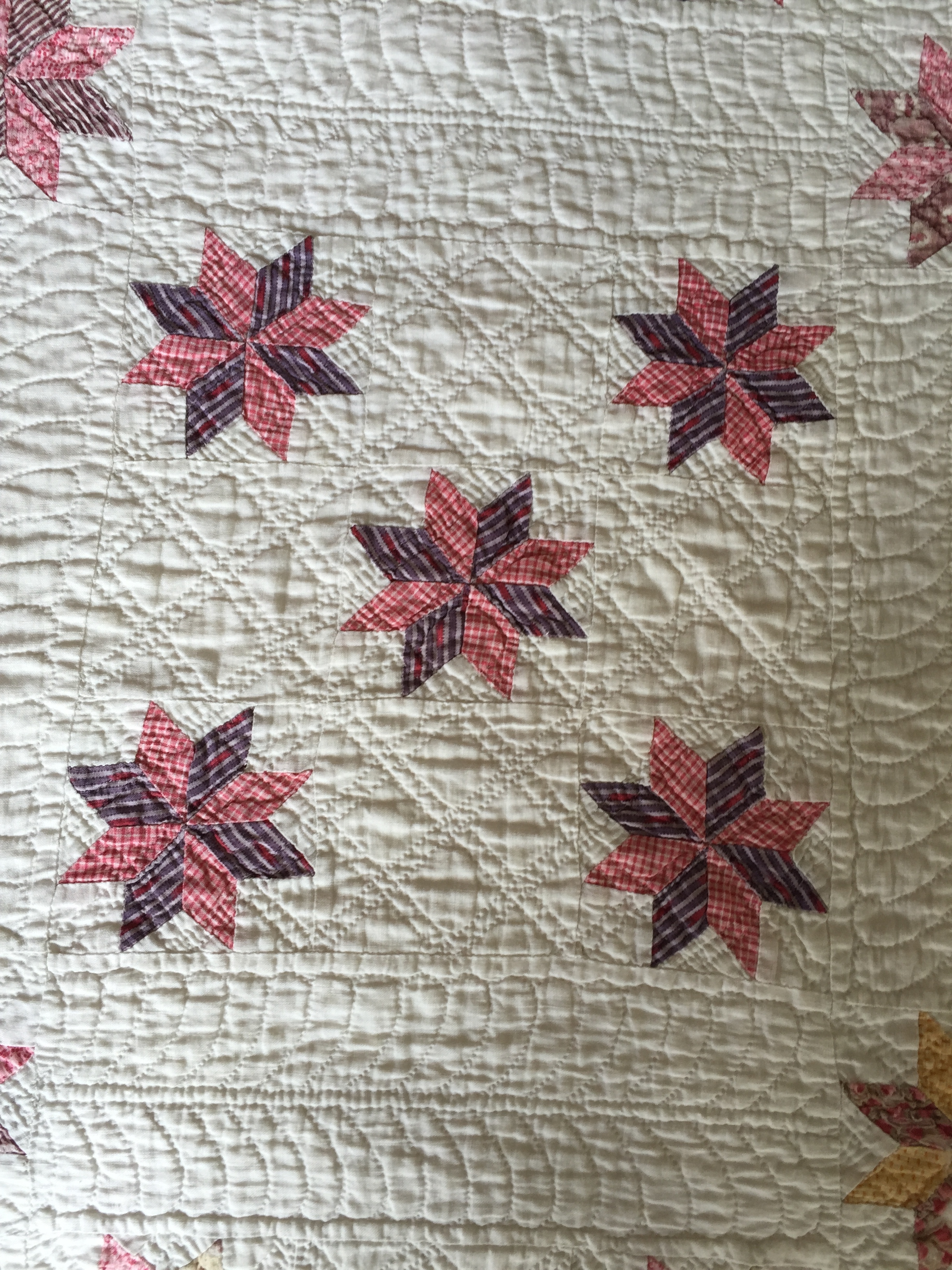
The maker of the LeMoyne Star Quilt was skilled in both piecing and quilting. The three inch LeMoyne Stars are constructed from eight tiny diamond pieces measuring approximately one inch in length. There are 345 stars in the quilt. Each star is accurately stitched with nice sharp points and the centre seams aligned perfectly.

Tiny LeMoyne Star

Tiny LeMoyne Star

The stars are stitched into a nine patch configuration and are set with three inch wide lattice strips. More LeMoyne Stars are placed as the cornerstones. Two plain borders were added with the remaining two borders made up of the lattice strips and star cornerstones.

Lattice and quilting detail

Lattice and quilting detail

The quilting is remarkable in both design and execution. The quilting consists of double cross hatching and feathers. There are 12 stitches to the inch, counted on the right side of the quilt. The batting is a lightweight cotton.

Unfortunately some of the fabrics used to piece the stars are extremely fragile and showing signs of wear.
This could be due to corrosive substances that were used in the dyeing process at this time. The white background fabric and the quilt backing are in excellent condition. I will eventually stabilise the weakened areas with tulle. Despite this problem the quilt is still a beauty. One can only wonder at the ability of this quilt maker to accurately stitch this intricate design with out the benefits of the sewing accessories available to quilters today.

LeMoyne Star Quilt

LeMoyne Star Quilt

Thank you for visiting, I am off to do some mending,
Janette, The Plain Needlewoman

Strippy Quilts – A Study in Frugality

26 Thursday Feb 2015

Posted by mcinnesjanette in Cumbria, English Quilts, hand quilting, North Country quilts, old fabrics, stitching, Strippy Quilts

≈ 6 Comments

Tags

Antique Quilts, Christopher Wilson-Tate, English quilts, Feedsacks, hand quilting, Strippy Quilts, The Donnellys

Strippy Quilt - circa 1850-70

Strippy Quilt – circa 1850-70

IMG_2583

Not in her wildest dreams, would the maker of this quilt have imagined that her quilt would turn up for sale at an antique market in rural Victoria in 2015. When I saw the quilt for sale on a vendor’s display, I knew immediately it was an old English Strippy quilt. The seller confirmed she had purchased the quilt from an Englishwoman living in Australia. The seller had owned the quilt for some years and had enjoyed using it on her bed.

On studying this quilt, I could see that it’s maker had joined fabrics together to achieve the length required and in one instance has used a different print to do so. This may indicate that the maker was utilising fabrics already available to her.

Two patterned fabrics joined to create length.

Two patterned fabrics joined to create length.

The quilt is constructed of eleven – 8 inch wide strips. There are five different fabrics used in this charming and humble quilt. The quilt is quilted in an all over zig zag design. I suspect it was quilted from the back as the stitches are very even on the back when compared to the front.

Back of quilt showing hand quilting detail.

Back of quilt showing hand quilting detail.

I contacted Christopher Wilson-Tate, the owner of Antique Textiles Company, UK who is an expert on English quilts. On seeing photos of my quilt Christopher identified the quilt as a typical North Country Stripe from Cumbria/Lake District. The simple wave quilting is typical of this area. Christopher thinks the quilt was made about 1870 or possibly earlier. Thank you Christopher for your knowledge and expertise

Patches.

Patches.

.

The quilt measures 84 inches by 85 inches and there is some wear on the vertical edges. A couple of little patches stitched onto the quilt only adds to it’s charm.

With clever joining of her fabrics and an orderly placement of contrasting colours this frugal quilt maker was able to celebrate her thrift and personality in a quilt that has had an interesting journey beyond its humble beginnings.IMG_2550

IMG_2551

Fabrics Make the Quilt!

Fabrics Make the Quilt!

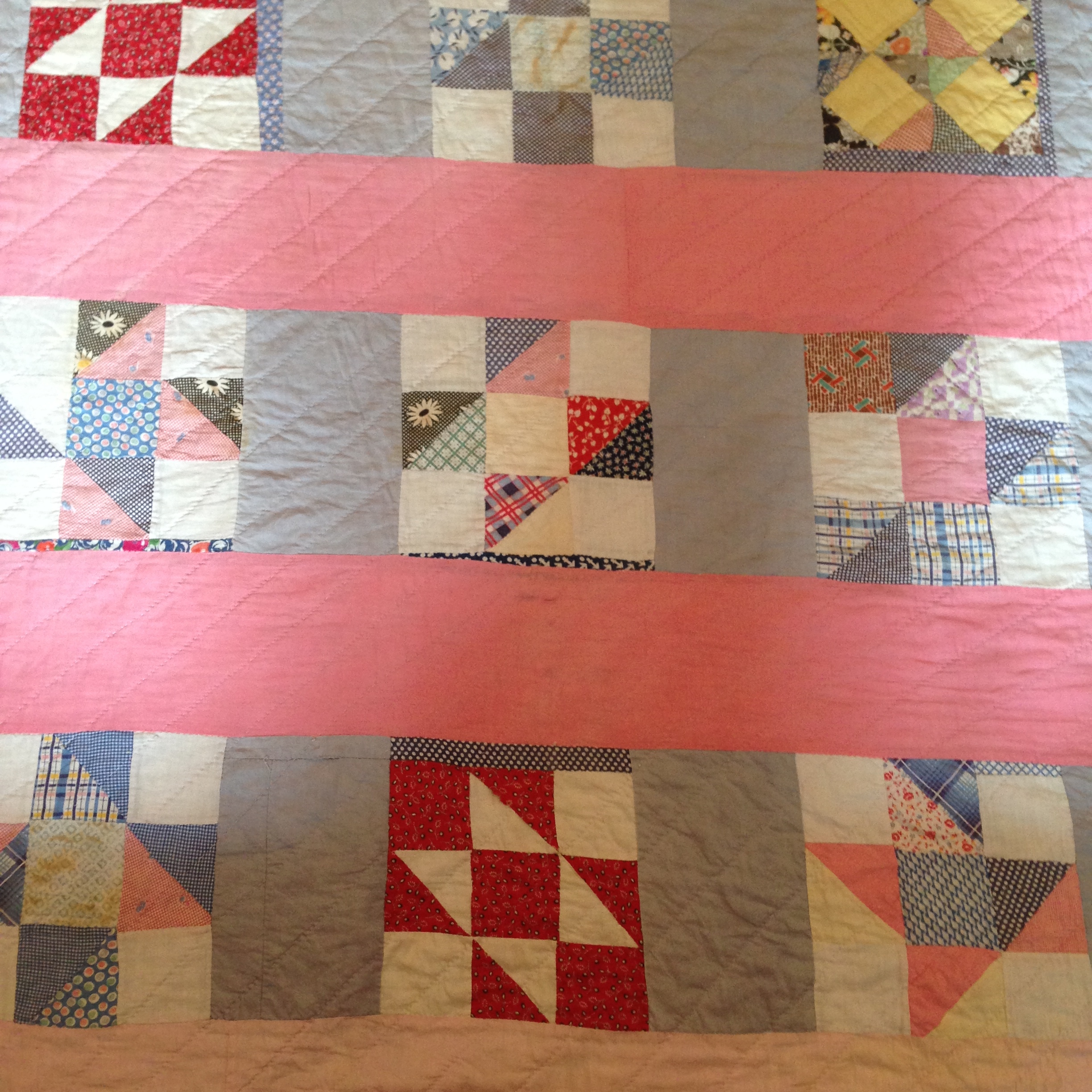
Travelling in time and crossing the Atlantic Ocean to arrive in Tennessee USA we have another Strippy Quilt that demonstrates frugality and verve. This quilt was purchased by the Donnelly’s (quilt collectors) in 1997 at the Donnelly House, Mountain City, Tennessee. It measures 86 inches by 87 inches.
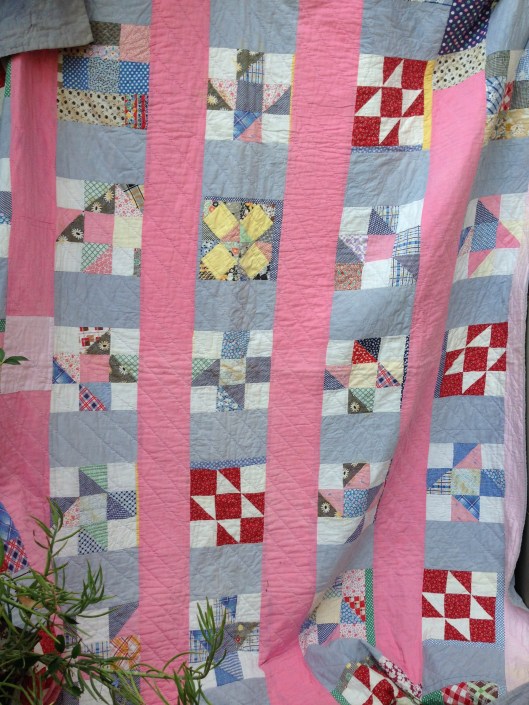
American Strippy.

American Strippy.

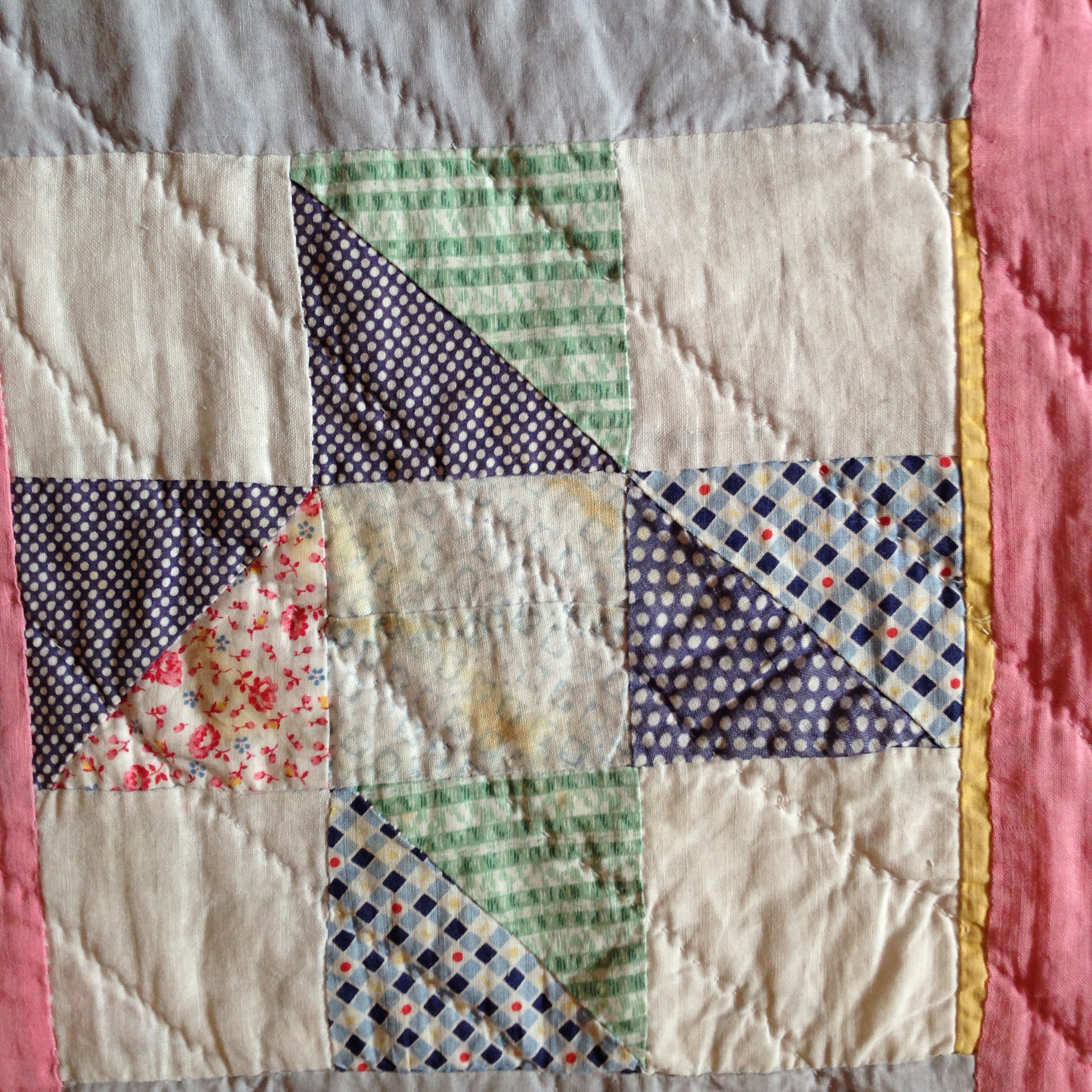
The assorted blocks that make up this quilt consist of stars, nine patch and album. The quilt maker was not constrained by size, fabrics or colours. Many of the blocks have small strips added to make them fit.

Yellow strip added to  size up the block.
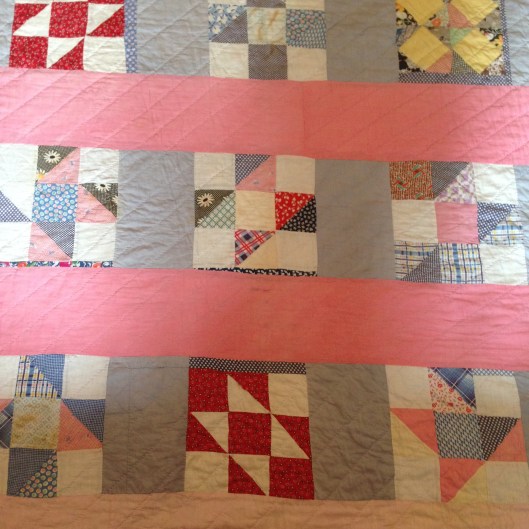
Yellow strip added to size up the block.

Detail of blocks used.

Detail of blocks used.

The blocks date from circa 1880 through to 1930. The fabrics consist of shirtings, dress fabrics and feed sacks. The strippy lay-out was achieved by joining the blocks with a hand dyed blue/grey fabric (probably faded over time) and then set into the strippy lay out with the pretty pink solid fabric.

The backing is the same dyed blue/grey fabric which appears to be plain feed sacks as a feint print of lettering and a feed sack symbol is visible.

Hand dyed backing

Hand dyed backing

Block detail with hand quilting.

Block detail with hand quilting.

Frugal use of scraps

Frugal use of scraps

Eileen Donnelly named this quilt ‘She did the best she could with what she had’, which I think is a perfect name and what I now call the quilt as well. I think this quilt maker stitched a life time of quilting into a quilt that is a testimony to a frugal and creative quilt maker.

I would like to share this lovely print of a Plain Needlewoman working on a hexagon quilt.IMG_2455

Thank you for visiting, yours in quilting, Janette – The Plain Needlewoman

A Trip Around the World or Two

22 Thursday Jan 2015

Posted by mcinnesjanette in hand quilting, old quilt tops, stitching, Trip Around the World, vintage quilts

≈ 6 Comments

Tags

1930s quilts, Antique Quilts, Fabric Study, feed sacks, handquilting, old quilt tops, old quilts, Postage Stamp quilts, Trip Around the World

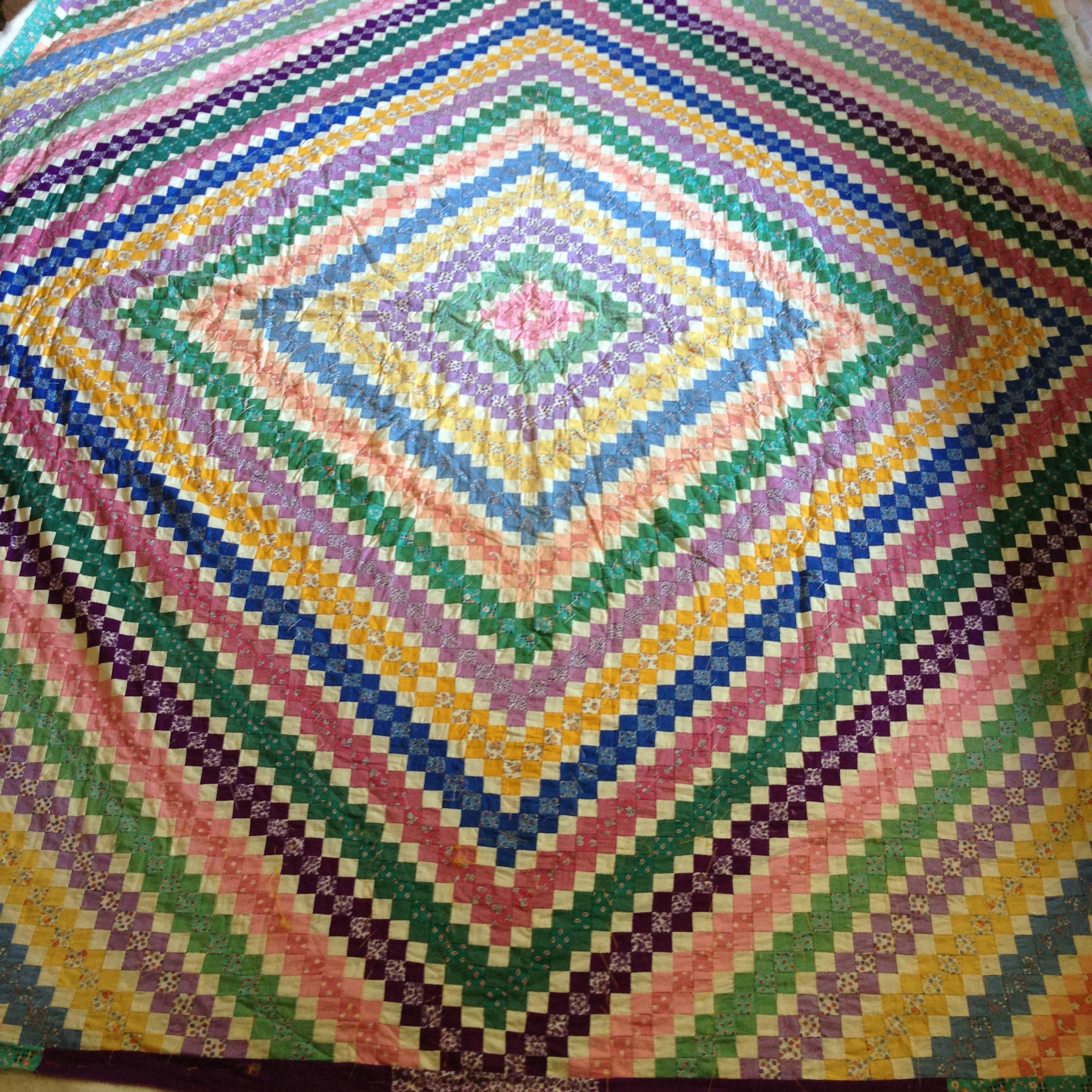
Trip Around the World - setting one

Trip Around the World – setting one

Trip Around the World - setting Two

Trip Around the World – setting Two

If You wish to take a trip around the world today, you only have to book a ticket with an airline and off you go. Paris, London, New York, Rome or Melbourne can be your destination.

To quilt makers of the grand quilt making epoch of the Thirties and Forties, a trip around the world would have been an incredible dream.

However, during this era ‘A Trip Around the World’ was made not by boat or plane but by cutting numerous tiny squares of fabrics and stitching these squares together to create quilts of great style and design. These quilts also demonstrate a sophisticated use of colour and pattern.

Wonderful use of colour

Wonderful use of colour

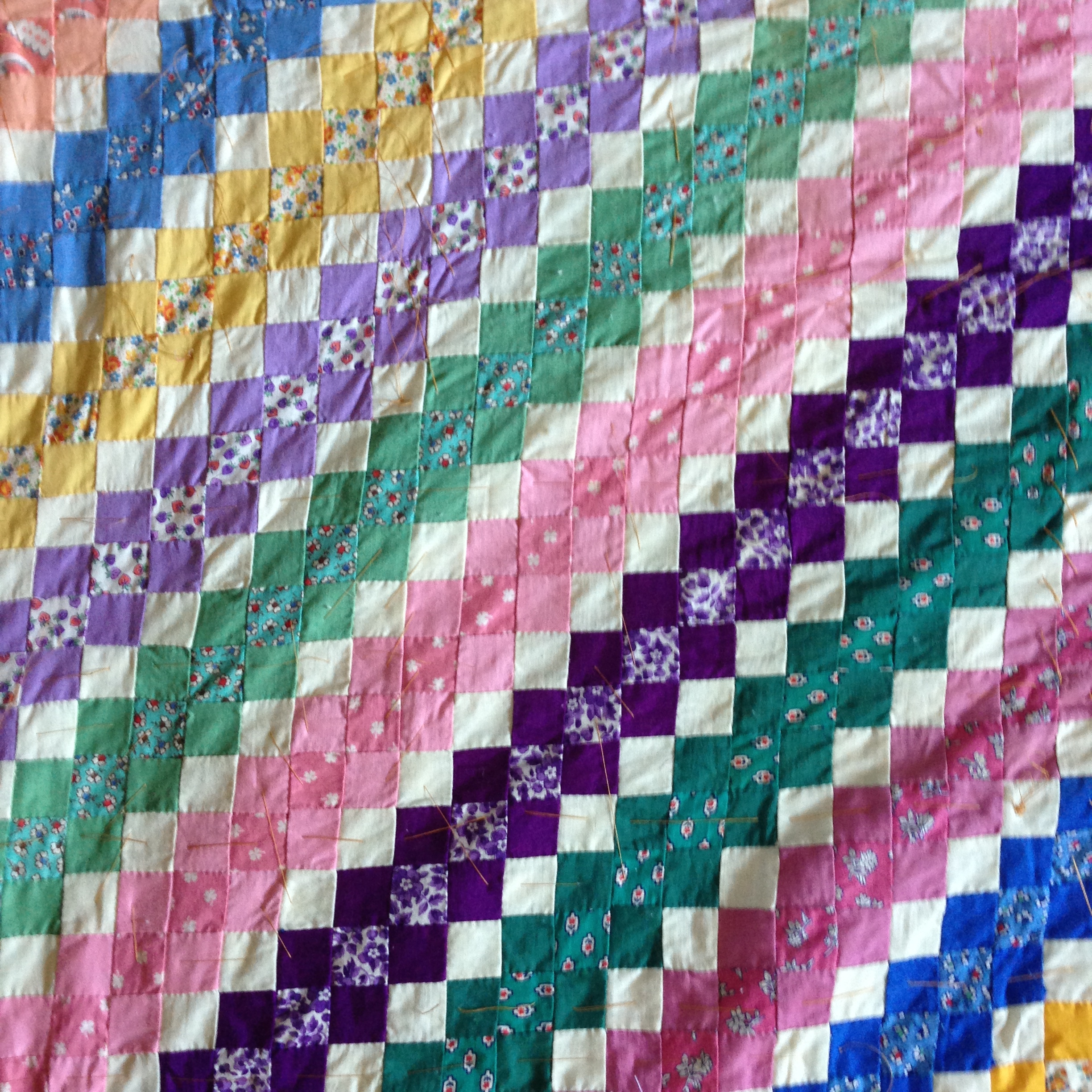
Tiny Squares - these measure 3/4 of an inch finished.

Tiny Squares – these measure 3/4 of an inch finished.

In Barbara Brackman’s Encyclopedia of Pieced Quilt Patterns these two Trip Around the World designs are to be found.

This design is identified as Trip Around the World - - Aunt Martha and Home Art

This design is identified as Trip Around the World – – Aunt Martha and Home Art

The second design is accredited to Holstein and also called Trip Around the World.

The second design is accredited to Holstein and also called Trip Around the World.

My quilts represent examples of both these designs. In the book ‘The World of Amish Quilts’ by Rachael and Kenneth Pellman. The Pellmans state that this arrangement of squares was a favoured design predominantly made in Lancaster County, PA. from where it spread to other Amish settlements. The Amish call this design Sunshine and Shadows. These quilts were made in solid colours and nearly always featured at least one large border. It is also stated that ‘the squares are arranged by colour to form a series of brightly coloured expanding diamonds. Sometimes the squares are tipped on point to form a pattern of squares. The Pellmans also state the ‘the Sunshine and Shadow arrangement of squares worked in printed fabrics rather than plain, may be called Trip Around the World and is often made by non-Amish women’.

I purchased the Trip Around the World quilt from the collection of The Donnellys. They bought this quilt in Groton, Massachusetts in 1995 at The Quilt Loft from Dianne Reece. It is hand pieced and quilted. The squares measure 1 inch finished and the quilter has used a great variety of fabrics, including dimity, feedsacks, shirtings and early dress fabrics. The inclusion of the solid red and black in this quilt shows the quilt maker’s great flair for colour and design. The quilt contains 3,125 squares. The backing is a plain white homespun which displays the lovely hand quilting to great effect. The binding on this quilt is noteworthy as it is stitched around the edges of the tiny squares, creating a dainty scallop finish.

Binding detail

Binding detail

The second Trip Around the World Quilt in my collection was bought as a top from the quilt collector Jan Baker. I have basted this quilt and hope to start quilting it this year. The squares in this top are even smaller, three quarters of an inch finished. This Trip Around the World is an example of the quilt maker tipping it on point. The edges finish square so there is no fiddly binding to be done. This quilter came up with a nice border design for her quilt.

section of border

section of border

The fabrics in this quilt appear to be very well co-ordinated. The pretty, little floral patterns match up with a complimentary solid colour. On studying this quilt, I wonder if it is an early example of a kit quilt, which were available at this time. Well, I will have lots of time to examine the fabrics and think about the original quilt maker when I undertake the task of hand quilting it.

I consider myself extremely privileged to have two Trip Around the World Quilts in my collection. I hope you might be inspired to create your own, as one of my friends already has. Good Luck, Sally and Happy Stiching to you all. Janette, The Plain Needlewoman
With my quilt

With my quilt

← Older posts
Newer posts →

Recent Posts

  • (no title)
  • Cathedral Window Quilt circa 1930s
  • Marjie”s Star Quilt
  • Australian Crazy Quilt
  • Clarence Valley Coverlet No. 2

Recent Comments

mcinnesjanette's avatarmcinnesjanette on Marjie”s Star Quilt
Lowana Radel's avatarLowana Radel on Marjie”s Star Quilt
Jill's avatarJill on My Wagga Quilt
mcinnesjanette's avatarmcinnesjanette on My Wagga Quilt
Sherry's avatarSherry on My Wagga Quilt

Archives

  • January 2021
  • February 2019
  • November 2018
  • July 2018
  • June 2018
  • May 2018
  • April 2018
  • September 2017
  • June 2017
  • April 2017
  • March 2017
  • February 2017
  • November 2016
  • October 2016
  • September 2016
  • August 2016
  • July 2016
  • June 2016
  • May 2016
  • April 2016
  • January 2016
  • December 2015
  • November 2015
  • October 2015
  • September 2015
  • August 2015
  • July 2015
  • June 2015
  • May 2015
  • April 2015
  • February 2015
  • January 2015
  • December 2014
  • November 2014
  • October 2014
  • September 2014
  • August 2014

Categories

  • 19th century Madder Fabrics
  • antique fabric
  • antique quilts
  • appliqué
  • Australian Quilts
  • Cathedral Window Quilts
  • Christmas
  • Crazy Quilts
  • Cumbria
  • d'oyleys
  • Doll Quilts
  • Double Pinks
  • English Quilts
  • Feed Sack
  • hand piecing
  • hand quilting
  • handquilting
  • hexagons
  • Mary Brooks Picken
  • Mending
  • North Country quilts
  • old fabrics
  • old quilt tops
  • Old Quilts
  • old sewing books
  • Paper Piecing
  • Postage Stamp Quilts
  • Quilt Collections
  • Quilt Restoration
  • Quilt Stories
  • quilting projects
  • red and green quilts
  • Red and White quilts
  • Redwork
  • Repairing old quilts
  • Scrap quilts
  • Sewing machines
  • Signature Quilts
  • Singer Sewing Manuals
  • Spider Webs
  • stitching
  • Stripe Quilts
  • Strippy Quilts
  • Trip Around the World
  • Turkey Red
  • Uncategorized
  • vintage quilts
  • Waggas
  • Welsh quilts
  • Yo-Yo quilts

Meta

  • Create account
  • Log in
  • Entries feed
  • Comments feed
  • WordPress.com

Recent Posts

  • (no title)
  • Cathedral Window Quilt circa 1930s
  • Marjie”s Star Quilt
  • Australian Crazy Quilt
  • Clarence Valley Coverlet No. 2

Recent Comments

mcinnesjanette's avatarmcinnesjanette on Marjie”s Star Quilt
Lowana Radel's avatarLowana Radel on Marjie”s Star Quilt
Jill's avatarJill on My Wagga Quilt
mcinnesjanette's avatarmcinnesjanette on My Wagga Quilt
Sherry's avatarSherry on My Wagga Quilt

Archives

  • January 2021
  • February 2019
  • November 2018
  • July 2018
  • June 2018
  • May 2018
  • April 2018
  • September 2017
  • June 2017
  • April 2017
  • March 2017
  • February 2017
  • November 2016
  • October 2016
  • September 2016
  • August 2016
  • July 2016
  • June 2016
  • May 2016
  • April 2016
  • January 2016
  • December 2015
  • November 2015
  • October 2015
  • September 2015
  • August 2015
  • July 2015
  • June 2015
  • May 2015
  • April 2015
  • February 2015
  • January 2015
  • December 2014
  • November 2014
  • October 2014
  • September 2014
  • August 2014

Categories

  • 19th century Madder Fabrics
  • antique fabric
  • antique quilts
  • appliqué
  • Australian Quilts
  • Cathedral Window Quilts
  • Christmas
  • Crazy Quilts
  • Cumbria
  • d'oyleys
  • Doll Quilts
  • Double Pinks
  • English Quilts
  • Feed Sack
  • hand piecing
  • hand quilting
  • handquilting
  • hexagons
  • Mary Brooks Picken
  • Mending
  • North Country quilts
  • old fabrics
  • old quilt tops
  • Old Quilts
  • old sewing books
  • Paper Piecing
  • Postage Stamp Quilts
  • Quilt Collections
  • Quilt Restoration
  • Quilt Stories
  • quilting projects
  • red and green quilts
  • Red and White quilts
  • Redwork
  • Repairing old quilts
  • Scrap quilts
  • Sewing machines
  • Signature Quilts
  • Singer Sewing Manuals
  • Spider Webs
  • stitching
  • Stripe Quilts
  • Strippy Quilts
  • Trip Around the World
  • Turkey Red
  • Uncategorized
  • vintage quilts
  • Waggas
  • Welsh quilts
  • Yo-Yo quilts

Meta

  • Create account
  • Log in
  • Entries feed
  • Comments feed
  • WordPress.com

Blog at WordPress.com.

  • Subscribe Subscribed
    • The Plain Needlewoman
    • Join 111 other subscribers
    • Already have a WordPress.com account? Log in now.
    • The Plain Needlewoman
    • Subscribe Subscribed
    • Sign up
    • Log in
    • Report this content
    • View site in Reader
    • Manage subscriptions
    • Collapse this bar
 

Loading Comments...